



George Buist, the last know returned soldier arriving at St Helena Island in September 1920 as a warder, was only on the island for 9 months. Not much happened, excepting a miscount of a prisoner at evening muster in C Wing. But his war service deserves a special mention as not too many men met and married their wife and had a child all while on active duty.


George Buist’s story shows how complex life can be for one individual, but it opens a window onto women and children’s attempts to find a way to make it through life as he was married 3 times. The story begins in Fife, Scotland in 1883, where he was born and later became a Maltman. By the time he married his first wife Mary Ann Garrity in 1908, he was living in Edinburgh, and they were still there when daughter Mary Ann was born on the 26th April 1911.
Tragedy followed, as the mother Mary Ann died from childbirth on the same day. There is no telling how any of us would psychologically react to such a terrible event following on from the birth of our child, but George obviously did not cope. He boarded a vessel bound for Australia on the 8th May. By the time he arrived on June 21, 1911, he had no way of telling how his daughter, in the care of her Grandmother was faring. Infant Mary Ann died in the Edinburgh Sick Children’s Hospital on the 25th August 1911.

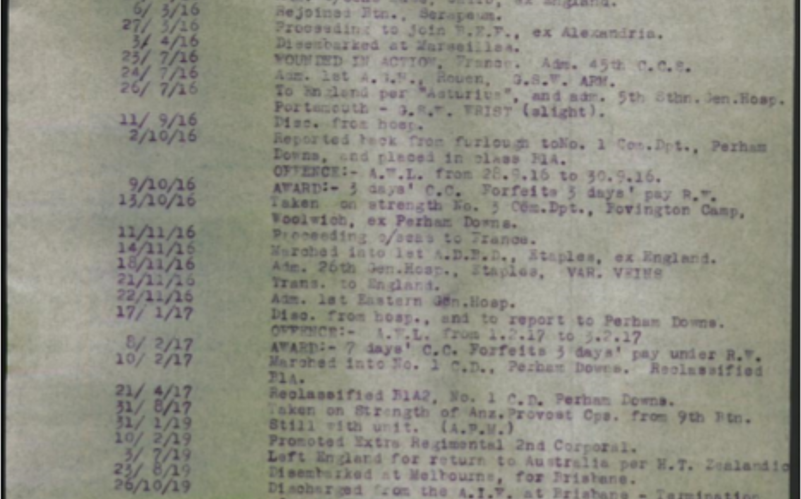
George remained in Queensland and was in Childers when he enlisted in WWI on the 30 January 1915, returning to the Northern Hemisphere where he took part in battles at Gallipoli, Africa and France as part of the 9th Battalion. He was hospitalised many times, for Diarrhoea, Gunshot wound and Varicose Veins. In 1915, 1916 and 1917, George was days late returning from each furlough following his hospital discharges in England. This literally cost him, as he was fine 5 pounds and twice forfeited 3 day’s pay. It seems, though, there was a reason, as on the 28th April 1917 George was married in the Paddington Registry Office.
At this time George was in the Perham Downs Camp in Ludgershall, England, attached to the Australian Army Provost Corps. The Provost Corps were in charge of traffic duties, maintaining army discipline, security, Prisoners of War and the management of Military Prisons. By transferring into the Corps, George remained in England and was present for the birth of son George in July 1917. When he was shipped to Australia (still on active duty) on the 3rd July 1919, his wife Gladys and son George travelled to Australia with him.


100 years ago people were rebuilding their lives again. Finding a way into employment as a warder in a prison on an island in Australia was far removed from George Buist’s previous occupation as a Maltster or his role as a soldier. But his wives had their lives changed completely also, thanks to the arrival of their children, and it seems that adaptation to changing life circumstance and geographical location in the world was the job of men and women alike post World War I.
For the prison management of St Helena Penal Establishment, dealing with an influx of temporary, untrained ex-soldiers over 5 years must have placed great pressure on the prison. Training people with little insight into the role, with potentially little motivation to actually have a career as a warder and having to train them while maintaining the security of the prison must have been a major undertaking. In the year 1916 alone, the new Superintendent arrived, 15 warders were appointed, 5 were placed on the island temporarily, 4 left and 2 warders died. Up until 1921, some of these men stayed a month or two and some stayed for years, some were efficient and some underperforming in their duty to an extent that they were not asked to continue their duties.


I am unsure if George was treated by the Government as a Returned Soldier to be employed in Government Institutions or whether he found employment on St Helena Island himself as it took 11 months between discharge from the army to him taking up duty on St Helena. With a wife and child newly arrived in Australia, island life would have created great difficulties in communication and housing for the family. After only 9 months on the island, George resigned from St Helena with no reason given on the 29th June 1921.
In 1921, staff in St Helena Penal Establishment were reduced from 45 to 16, with the Comptroller General Charles Pennefather reporting that ‘a fair number of men (warders) will be absorbed in other gaols.’ It seems every prison staff member was asked to make a decision about their future at this time – stay on the island, transfer to Brisbane Prison or another gaol in the state, retire or resign.


A transfer to Brisbane Prison may have helped George Buist retain a wage, but the role of a warder may not have been something George wished to continue. He chose to resign. George finished his life as a Newsagent in Middlesex with his third wife, a long way from Moreton Bay and his former life.