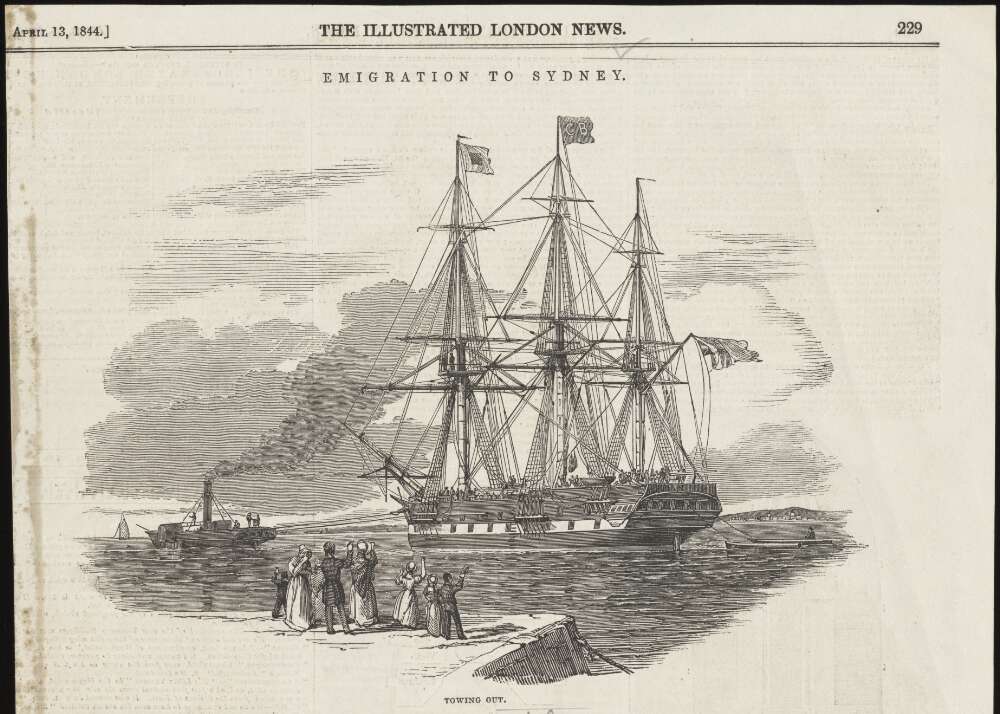
Towing out.” An immigrant ship leaving London bound for Australia, a scene repeated many times in the 1800’s. Sourced from The National Library of Australia, Towing out. (nla.gov.au)
Our last story ‘New arrivals, new stories and old mysteries – 1862’ gave us new insights into the burials on St Helena Island, Moreton Bay, Queensland when the ship ‘Erin-Go-Bragh was quarantined there in 1862. Wading through mud and forced to live on board the diseased ship or on the island in tents, the newly arrived passengers and crew of the ‘Erin Go Bragh’ had a rough introduction to life in Australia. But thankfully, all passengers had been transferred to Brisbane by the 11th August 1862. On the 12th August 1862, the ‘Chatsworth’ anchored in the lee of the island where the Erin go Bragh had just been quarantined.
This image of St Helena Island, Moreton Bay, sketched in 1853 shows the most sheltered side of the island, with a natural bay formed by the landscape. This is the most logical section of the island for sailing vessels newly arrived with immigrants on board to shelter while in quarantine. Sketch by Montagu of Beaulieu, Henry John Douglas-Scott-Montagu, Baron, 1832-1905. (1853). St. Helena, Moreton Bay, 20th July, 1853 [picture] / H.S. http://nla.gov.au/nla.obj-134723485
The ‘Chatsworth’ left Liverpool on the 5th April 1862. Once out on the open ocean, measles broke out on board and this eventually accounted for 12 deaths at sea, especially that of children. On arrival in Moreton Bay in Queensland on the 6th of August 1862, the Chatsworth was placed into immediate quarantine at anchor due to cases of measles still being present on board and a child or children were buried immediately on Moreton Island at the entrance to Moreton Bay.
A letter from the ship’s surgeon, Charles J. Moran, on the 12th of August stated that the Chatsworth had been moved on to St. Helena Island for quarantine, just as the ‘Erin Go Bragh’ had left. Tents were erected on the island for basic shelter and food and other supplies were delivered via boats from Brisbane. 2 Dr Moran suggested that:
‘the health of the ship is good and that the greater number of the passengers had been landed on St. Helena Island and their clothes had been washed and the ship had also been fumigated. 3
The Southern Flats of St Helena Island were not always open green rolling hills. While areas close to the shoreline offered some space, low scrub and forest covered the bulk of the island. Image: Amanda Wright.
However, in actuality typhoid fever had broken out amongst some adult passengers. On the 18th August, a letter was sent to the mainland, written by ‘Chatsworth’ passenger James Jeffrey, an Admiralty Surveyor in the Royal Navy. He noted “About 50 of the passengers are landed on the Island of St. Helena, two children and one man died on the island last week, and one woman has been landed this morning, some of the passengers refuse to land.” (3)
Official records in the form of death certificates confirm 7 deaths and burials on St Helena Island, before the Chatsworth was finally towed to the permanent quarantine ground at Dunwich, Stradbroke Island on the 23rd of August and was released from quarantine to return to Brisbane on the 4th September.
Deaths and burials, St Helena Island for the ‘Chatsworth’ 1862.
Daniel and John Charles Drew
On the 18th August, a letter forwarded to the mainland, penned by James Jeffrey, an Admiralty Surveyor in the Royal Navy and one of the many detained passengers the Chatsworth mentioned the ‘two children and one man who died on the island last week.’ (3)
These first child death correlates to Daniel Drew, the 2½ year old son of Thomas and Ann Drew. Thomas, 24 year old labourer and his wife Ann, 31 years, were Scottish. Daniel died from convulsions and measles on the 14th of August. Sadly, younger brother John Charles Drew also died from measles on the 19th August 1862, five days later. Since the ship was still quarantined near St Helena, Daniel and John Drew were both buried on St Helena Island. (3)
Mary Isabella Scotland
Mary Isabella Scotland was the daughter of George and Elizabeth Scotland (nee Brown). The large Scotland family had emigrated from their home of Scotland – including father George (33), a Bank Clerk, Elizabeth (33), Jessie (7), George (5), Elizabeth (3) and Mary (1). While in quarantine on the 16th of August, Mary died from measles and was buried on St Helena Island. (3)
But worse was to come for the Scotland family over the next few months. Records show that less than a month later, on the 13th September 1862, daughter Elizabeth Angus Scotland also died in South Brisbane. Like her sister, Elizabeth also died from measles, which she had for 6 weeks. Only 2 months later, on the 18 November 1862, husband and father George Scotland died of ‘disease of the liver’ in Brisbane. Both George and Elizabeth were buried in the Presbyterian cemetery in Brisbane.
Sadly, only 3 months after arriving in Queensland, Elizabeth was alone with her two remaining children. While the family stayed for a short time, by 1871 they have already returned to Scotland. Ironically, the son George, eventually emigrated to New Zealand with his own wife and son.
Joseph Bradshaw
Edwin Bradshaw
James Jeffrey’s letter also identified that one man had also died on the island. It was around this time that Joseph Zadock Bradshaw, aged 29 years, became ill with Typhoid fever and died on the 17 August 1862.
The letter, however did not recognise that on the same day, his 2 year old son Edwin Elias Bradshaw also died of dysentery and general debility. Despite the confusion, it would appear that Edwin was also buried on St Helena Island along with his father. (3)
English born Joseph Zadock Bradshaw and his wife Ellen Bradshaw (nee Daniel) emigrated on board the ‘Chatsworth’ from Staffordshire. They had married in 1853 and emigrated to Brisbane in 1862 with their children Mary 8, Henry 6, Keziah Ann 4, Joseph 2, and Edwin 1 and Ellen was also pregnant with her sixth child. 4
Ellen Daniel/ Bradshaw / Smith arrived in Queensland, Australia in 1862 and lost both her husband and one son within weeks of her arrival. Pregnant with her 6th child, Ellen story of survival in an unknown land indicates she was a strong and remarkable woman. Image sourced from http://www.womenoffibre.com.au/bradshaws/ellen-daniel-and-aunty-lou/
When the Chatsworth was finally cleared on the 4th September to enter the Port of Brisbane, Ellen Bradshaw was alone in creating a new life in a foreign land, responsible for 4 children and while giving birth to her sixth child, Louisa, on 6th September 1862 in Brisbane. 5
Ellen Bradshaw was known to run a grocery shop in James St, Fortitude Valley, Brisbane. According to stories, she met Frederick Tarver Smith when taking her children to Sunday School in Milton where he was a teacher. Despite both being widowers, they did not get married straight away, having 3 children out of wedlock before being married in April 1872 in Sydney, where Frederick Smith Jnr was living. On returning to Qld, they lived in various localities including Stanthorpe, Gympie and Brisbane. Frederick worked as a contractor and Ellen had a further 3 children, making her the mother of 12 children in total. (4) (5)
In 1881, a letter was forwarded to Superintendent John McDonald of St Helena Penal Establishment. 6 The letter read:
8th May 1881 Letter from Mr Smith. Requesting permission to access the island. His wife wishes to visit the grave of her first husband and bring her son and daughter and Mr Smith with her. Her first husband was Joseph Zadock Bradshaw who arrived in August 1862 on the Ship Chatsworth. He died on St Helena of Typhus before being allowed to leave the ship for Brisbane. John McDonald Superintendent, St Helena Penal Establishment
It is not known if permission was granted for the visit, but it does indicate that nearly 20 years later, Ellen Bradshaw had not forgotten the events on St Helena Island that had taken both her husband and son. Ellen reached the age of 88 years before dying in August 1922 and is buried in Toowong cemetery. (10)
In the week after James Jeffrey’s letter, more immigrants were to die before the ‘Chatsworth’ was moved to Stradbroke Island on or just after the 23rd August 1862.
Elizabeth/ Eliza Blake
George Blake
On the 22nd of August, a further two deaths would occur – that of 33 year old Elizabeth Blake from typhoid fever, the disease that appeared to be affecting more adults. On the same day, her 2-year-old son George Blake also died from measles. (3) Research from Liam Baker “The Haunts of Brisbane” confirm that Elizabeth was buried on St Helena Island (above right) and we can presume her son George would have been buried with her.
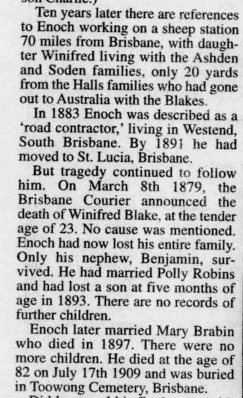
Enoch Blake featured in a news article highlighting the migration from Bedford, England to Australia of many of the towns people. Source: Bedworth Echo newspaper, 8 October 1998 Page 12
This left husband, Englishman Enoch Blake, to face the new life in Brisbane with their daughter Winifred, 6 years old. They appear to have lived in Bowen for a time, with Enoch remarrying to Mary Ann Brabin in 1874. Sadly, his remaining daughter Winifred died in 1879, aged 22. Enoch died in 1909 in Brisbane. 7
We can only imagine the heartache for these families as they left their loved ones buried on a remote island while they headed to Brisbane and a new life without them. While we are excited to finally know with certainty that these burials exist on St Helena Island, we cannot pinpoint their location with any degree of accuracy. All we can do is reflect on their story.
Nice to hear from you Penny. Glad you enjoy the story – there are so many fabulous stories associated with this island that it’s hard to know where to focus first! But our immigrant / quarantine history has remained unknown for too long, so I’m glad I finally have some facts to attach to share.
Who did you know who lived on the island? Was it one of the farm lesees?
Storyteller. Environmental Educator. Social history researcher. Interpreter of natural and cultural heritage. Writer. Teacher. Ecotourism Lecturer. Ex Ranger. Protector of our fragile planet. Collector of stories and keeper of memories. Explorer of special places. Lover of adventure and life.
View all posts by Belinda Daly
Discover more from The St Helena Island Community
Subscribe now to keep reading and get access to the full archive.










Very nice work love it . I know St Helena well I had a friend who lived on the Island.And when over lots of times . In the late 1970’s
Nice to hear from you Penny. Glad you enjoy the story – there are so many fabulous stories associated with this island that it’s hard to know where to focus first! But our immigrant / quarantine history has remained unknown for too long, so I’m glad I finally have some facts to attach to share.
Who did you know who lived on the island? Was it one of the farm lesees?