
Establishment
Moreton Bay, Queensland contains many small islands that once provided distant locations to house those who were deemed to be needing separation from mainland society. St Helena Island was one of these islands, initially providing a location for quarantining incoming immigrant ships from the 1840’s to the 1860’s. A new Quarantine Station, built by prisoners in 1866, was very short lived as pressure from overcrowding created a greater demand for a gaol. The lockup and Quarantine buildings were quickly converted into the beginnings of the St Helena Penal Establishment.
Officially opened in May 1867, the St Helena Penal Establishment initially housed 60 medium-term prisoners, who were faced with building and establishing a secure, disciplined male prison. The early focus was on clearing land and building the prison stockade, complete with cell blocks and corresponding exercise yards, a kitchen and hospital, as well as the Superintendents House and barracks for the Military Guard.

Sourced from the Mary Bell Collection, Qld Parks and Wildlife Service.
Industries and self sufficiency
St Helena P.E. was to be both a self-sufficient and a profitable enterprise. Building construction was done by prisoners using island resources – local cay sandstone or ‘beachrock’ was sourced from the quarry, a lime kiln built on the foreshore supplied cement and a clay quarry created smaller heat-resistant bricks. The 1870’s was a time of establishing a variety of industries with prisoners supplying the much-needed labour. The highly profitable sugar industry was created through extensive fields of sugar cane, which was processed and distilled on the island in the island’s sugar mill. Vegetables and maize as well as pigs and sheep provided food sources for the island’s inhabitants.
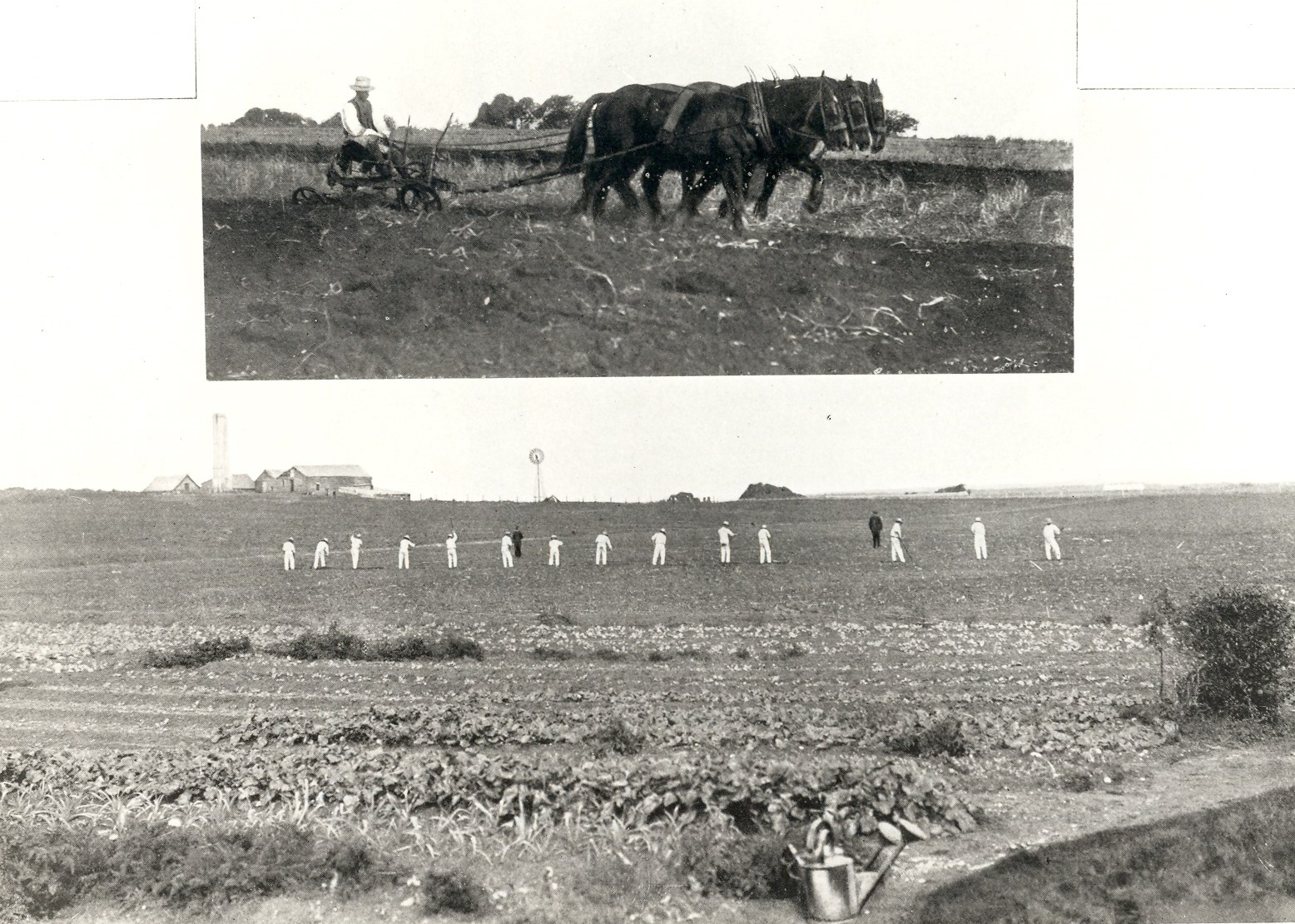
While isolation might reduce the chance of escape, it provided further challenges for transport. Boats found it difficult to land in the shallow intertidal zone, requiring a lengthy causeway and jetty to be built. A tram was established on the island in 1878 to move goods around and this was in fact the first tramway in Brisbane. Distance also reduced the ability to communicate effectively with the mainland about important issues and this was addressed with establishment of a telegraph line in 1879.

Consolidation
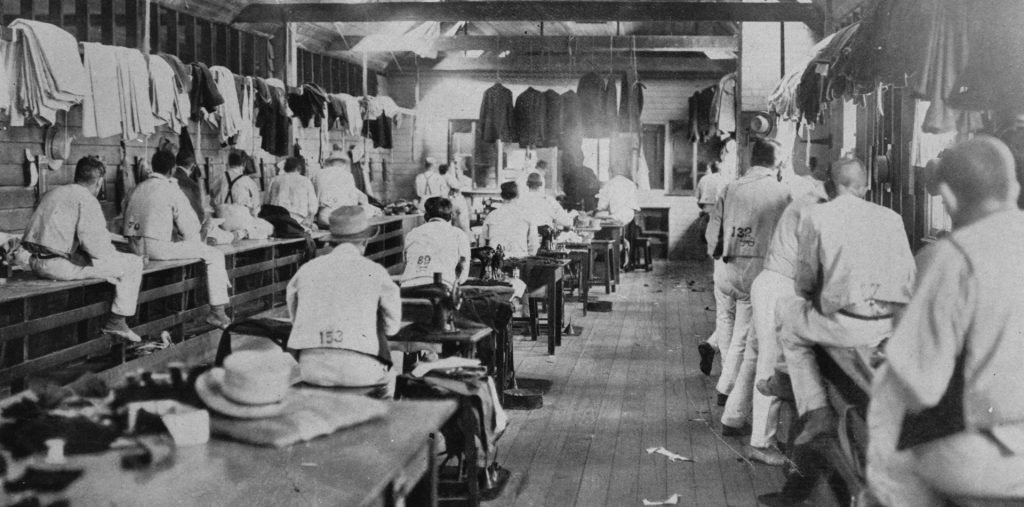
St Helena Penal Establishment eventually became the major prison in Queensland for the incarceration of long-term prisoners. Prison management centered around the core concepts of resstriction of freedoms, punishment and hard labour. This was achieved through enforcement of strict regulations around behaviour, punishment for misdemeanours, regular routines and prisoners being employed at work for 5 1/2 days per week. Workshops for tailoring, shoe making, saddle making and tin smithing were established in 1887, when two large purpose-built workshops were established in the prison stockade. These workshops employed the majority of prisoners within the penal establishment, who were trained by qualified by Trade Instructor warders and goods supplied both the island and the mainland.
Growth
By the 1890’s, St Helena was a major penal establishment, reaching the maximum prison population of 350 prisoners. Many of these were long term prisoners convicted of murder, manslaughter or other violent crimes. The 1890’s also brought forth new considerations for prison management, with Comptroller General of Prisons, Charles Pennefather, spearheading ideas around ‘reform’ rather than ‘punishment.’ New prison regulations emerged, detailing a new classification system to categorise prisoners, while physical segregation occurred with new yards. Prisoners working in trades received training to develop a new skill set and others could access schooling or the new prison library to improve their literacy. A gratuity offered the means to earn some monetary recompense for work performed, crucial upon release, while the Salvation Army introduced a ‘Prison Gate’ program designed to assist the transition from prison into society once the prisoner was released.

Interestingly, the sugar production that had been the backbone of St Helena’s exports to the mainland was closed down and was replaced by a large Ayrshire dairy herd. Great pride was taken in the bloodstock of this herd, and in the production of milk, butter and cream utilised on St Helena and Stradbroke Islands and the mainland.
The final phase
Post Federation, St Helena Penal Establishment remained largely unchanged with regard to the shape and functionality of the prison stockade. Some new industries emerged as boutique industries designed to pioneer potential Qld wide industries, including Olive oil production and rope making from Sisal hemp plants. Neither became sustainable in the long term. The only major building construction was designed to improve the working life of warders, installing a recreation room, tennis court, swimming pool and Billiard table to relieve the boredom for warders in their leisure hours.

Despite Comptroller General Pennefather’s push for a new prison stockade to be built on St Helena, the decision was made in 1921 to downgrade the prison to a Prison Farm. On the 14th September 1921, 30 prisoners and 29 warders were moved to Brisbane Prison, leaving shorter termed prisoners within a prison whose main goal was now to reform prisoners. The last Acting Superintendent, Patrick Roche, implemented the highly regarded ‘Honour System,’ where Prisoners self-regulated their actions and behaviours and regulations were more relaxed.

Sourced from State Library of Queensland.
One task for the remaining prisoners was to dismantle many of the timber buildings due to the small numbers of prisoners remaining on the island. Much of the building material was recycled into other Government institutions and the two Trade workshops were transferred to Boggo Rd Gaol. Farming remained an important aspect of sustainability and employment for the remaining prisoners. St Helena Penal Establishment closed when the last prisoner left the island in 1932.