St Helena Penal Establishment was constructed by prisoners on the Prison Hulk in 1866. It began as a disciplined, isolated prison, with harsh conditions, strict adherence to regulations and maximum punishment for disobedience. Yet by the time it closed in 1932, it had been downgraded to a Prison Farm. Here, a small prisoner population farmed the land and discipline was delivered via an ‘Honesty System’. St Helena P.E. was a male only prison, with male prisoners guarded by male warders. But the commonality stops there, as St Helena P.E. contained a highly diverse group of people, with both prisoners and warders arriving at St Helena Island from all corners of the globe. With them they brought differences in cultural nationality, background, age, religion, education, employment, crime committed and previous incarcerations, making St Helena Penal Establishment a microcosm that reflected the global society its inhabitants came from.
St Helena’s prisoners were not convicts, as they were not sent from England as a punishment for crimes committed. St Helena’s prisoners arrived from all corners of the globe, but their crimes were committed in Queensland. Australia’s migration history can be clearly seen within these prisoners ranks, with 91 different birthplaces recorded in The St Helena Island Community’s prisoner database records. The majority are from England, Scotland, Ireland and Wales, emigrating from the mid 1800’s. Many nationalities arrived to find gold, including Chinese, North American, Canadian and most of the countries in Western Europe. All the Scandinavian countries are represented as are people came from the Caribbean Islands, South America and Africa. South Sea Islanders from a diverse number of islands in the Pacific came to work on Sugar Plantations as well as many people from modern day Malaysia, Singapore and Philippines and Indonesia. Aboriginal and Torres Strait Islanders are represented, as are people from every state in Australia. The most random of countries? – Siberia, Uruguay, Luxembourg, Madiera and ‘Born at Sea.’
| Name | Prison Admin. number | Country of origin | Crime |
| Ah Yam | 2980 | China | Manslaughter |
| Rahree | 4427 4524 | South Sea Islands | Indecent assault Attempting to steal |
| William Morrison | 1523 2540 | Isle of Man | Larceny Vagrancy |
| Carl Beag | 5371 | Chile | Unlawfully wounding with intent to do grievous bodily harm |
| Alic Ajax | 926 | Mexico | Larceny |
Name | Blog Stories – Prisoner countries of origin | ||
| South Sea Islander blackbirding A diary account of the slave trade | |||
| Aboriginal Johnny Lennon Johnny Lennon… locked up for singing in his Saint Helena cell | |||
| Richard Wynn St Helena Island is NOT a place for convicts… until now. | |||
Their trades and employment backgrounds were also varied, though Industrial workers (textiles, metals, roads and railways and carpentry) and Agricultural and mining workers (farming, livestock, drover/ stockman, labourer, gold mining) accounted for the vast majority of prisoners. In the 1860’s, sailors filled the Hulk and prison, due to deserting ship or disobeying captain’s orders, and captured bushrangers charged with Highway Robbery were jailed at St Helena. Many prisoners were involved in the supply of everyday goods, including butchers, bricklayers, blacksmiths, fishermen, and bootmakers. Some prisoners were under educated, though the vast majority could read and write. Educated prisoners can be seen in the ranks, as shop keepers, clerks, commission agents, dentists, accountants, engineers and school teachers. Perhaps the most interesting are the policemen and prison guards, who found themselves far removed from their usual existence when they found themselves on the wrong side of the law.
| Name | Prison Admin. number | Country of Origin | Occupation |
| Jospeh Bohdoskey | 4208 | Austria | Sailor |
| John Lightfoot | 13 x St Helena P.E. admissions | England | Umbrella Maker |
| Otto Heyde | 2743 | Denmark | Draughtsman |
| Joseph Grimshaw | 1303 | Ireland | Ex-policeman |
Name | Blog Stories – Prisoner occupations | ||
| Painter Charles Winn Islands of Exile: Part 2 – William Gould and Charles Winn | |||
| Painter Charles Winn Islands of exile, Part 3 – Charles Winn and St Helena | |||
| Teacher Michael Minnis ‘All I want for Christmas’ at St Helena Penal Establishment | |||
St Helena P.E. became the major penal establishment for long term prisoners in Qld. The majority of prisoners sentenced from 15 years to Life in prison for crimes such as murder, attempted murder, manslaughter and rape, were housed at St Helena more than any other Qld prison. Also common were crimes that could give 5 to 15 years, including assault, unnatural offences, unlawful wounding, arson and horse and cattle stealing. The majority of prisoners in the prison population at St Helena P.E. was for a sentence of 2-5 years, for crimes such as Burglary, Larceny and Receiving and Fraud. Sentences under 2 years were received for crimes such as obscene language, vagrancy, disorderly conduct, forgery and drunkenness. St Helena P.E. did receive prisoners that received the Death Sentence, but only those who had their sentenced further commuted to time in prison. No executions were carried out on St Helena Island at any time in the prison history.
| Name | Prison Admin. number | Crime | Length of Sentence | |
| William Bond, England | 1560 | Robbery Under Arms | 25 yrs P.S. & 50 lashes during first six months | |
| Alick, Malayta, S.S.I. | 4321 | Murder | Death commuted to Life | |
| Cornelius Horrigan Qld, Aust. | 5226 | Robbery with actual violence | 2 years 9 months | |
| Jimmy SSI/ Indigenous | 3650 | Wounding with intent | 12 years P.S. | |
| William Anderson, Norway | 6 x incarcerations | Vagrancy | 6 months Hard Labour | |
Name | Blog Stories – Prisoner crimes | |||
| The first Hulk prisoners Creating an island community | ||||
| Prisoners in 1920 and 1921 One Day In September on St Helena Island | ||||
| James MacPherson The Wild Scotchman | ||||
For many prisoners, this was their first offence and they made efforts to never return again. However, recidivism was not uncommon, with some prisoners becoming institutionalised and committing crimes very shortly after their last release, creating a cycle of incarceration that was to last the rest of their life.
56 identified prisoners did not leave St Helena Island – they died on the island and are buried in the prisoner’s cemetery located on the Southern Flats, with their Administration number in place of their name. 3 men died on St Helena but were buried on the mainland, while 7 men were transferred to Brisbane Hospital or Goodna Asylum shortly before their death. No prisoners were buried on St Helena after 1904.

| Name | Prison Admin. number | Crime | Death and burial |
| Charles Suttaby, Watchmaker | Hulk No 476 | Larceny | Died 01/02/1868 from Marasmus. First prisoner death and burial on St Helena. |
| Ah Yow Gardener | 2316 | Manslaughter | Died 18/12/1888 from continued fever, pneumonia, exhaustion. Buried St Helena. |
| Jackie Aboriginal man | 1514 | Robbery by force | Died 7/11/1884 from Phthisis and Tuberculosis Buried St Helena despite having a “horror of dying in prison.” |
| Jonathon Longland, Storekeeper | 4382 | Murder | Died 21/10/1904, from Senile decay and exhaustion. Last man buried St Helena Island |
| Frederick Cliff, Grazier | 2844 | Sheep Stealing | Died 2/05/1885 on St Helena Island from Typhoid fever. Family wish to take body to the mainland |
Name | Blog Stories – Prisoner crimes | ||
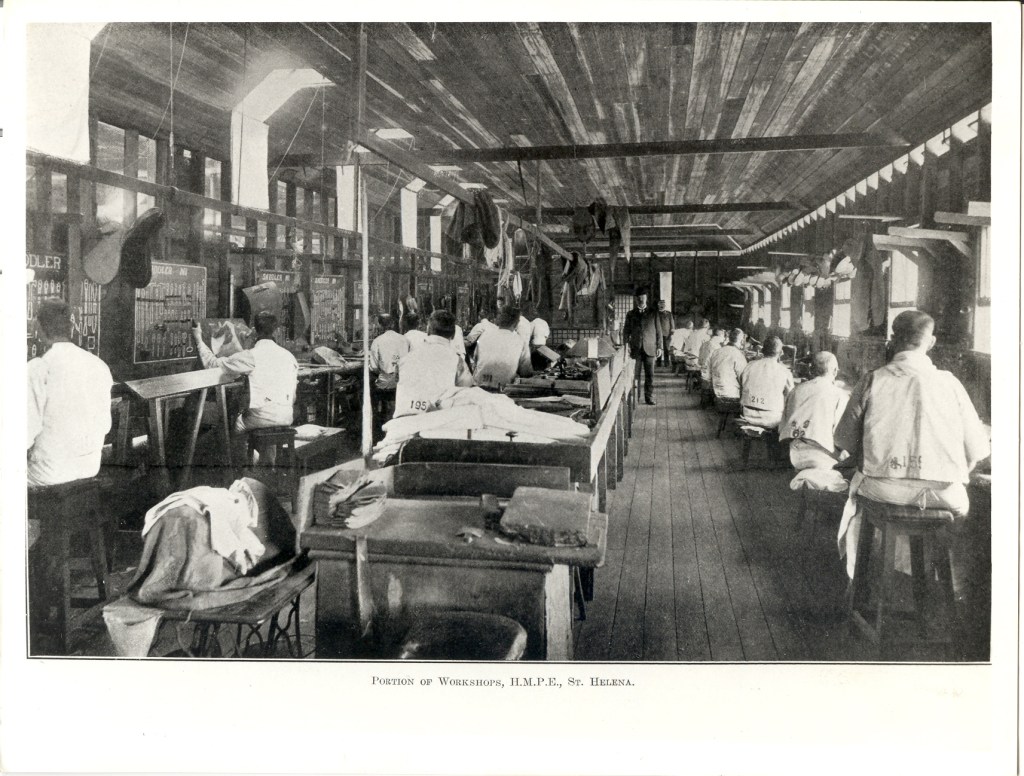
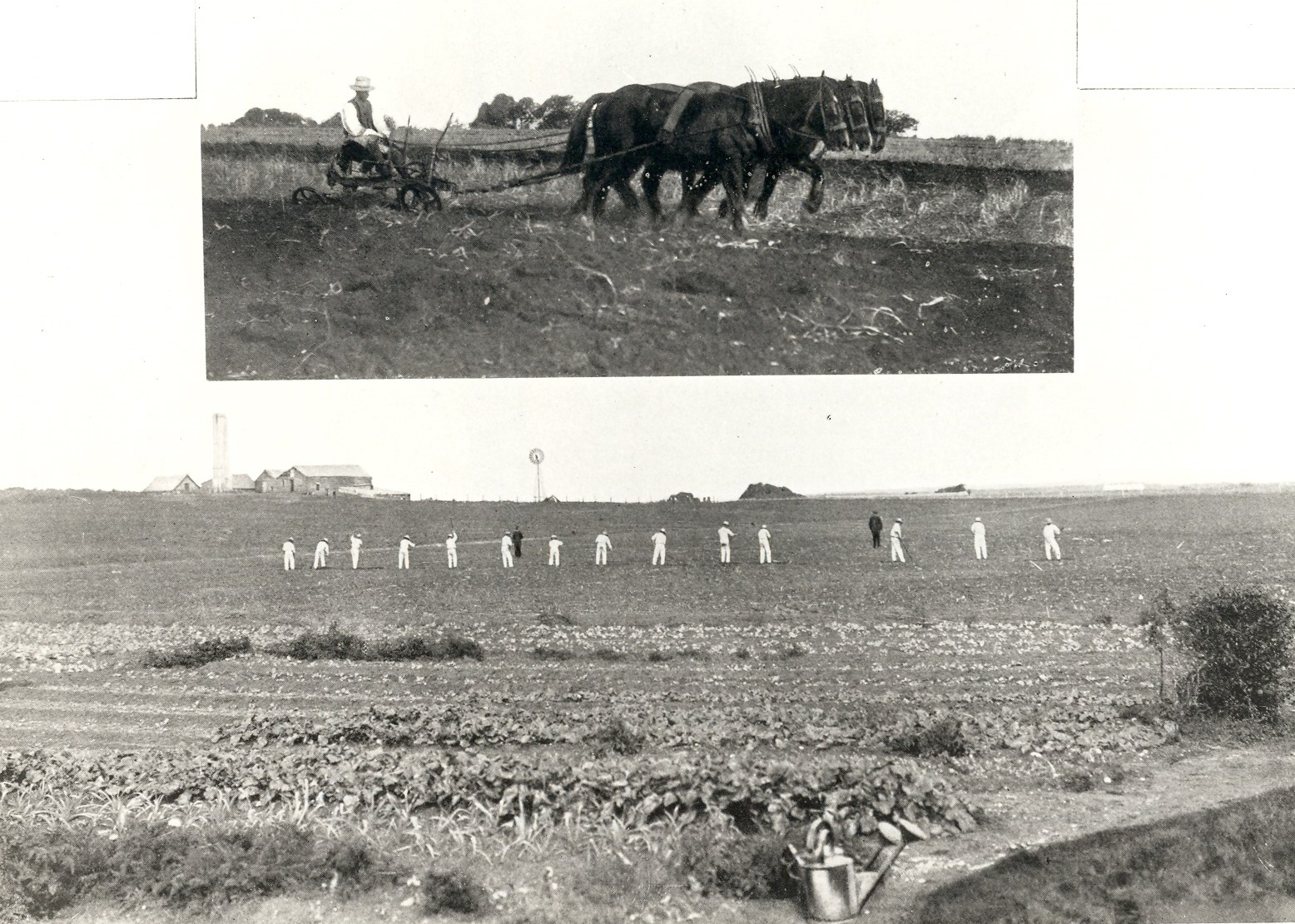
Prisoners sentenced to Hard Labour received specific duties once they arrived in the Penal Establishment. This could involve working in the outdoor gangs quarrying beachrock or making bricks, working in the sugar mill, construction of buildings, jetty or the food production chimneys, making roads or laying railway tracks, or toiling in the field producing crops or tending to livestock. Others sentenced to Penal Servitude only might find themselves working at a trade – hammock making, bootmaking, tailors, saddlemakers, tinsmiths, blacksmiths, butchers or cooks. Trusted prisoners would be servants in the Superintendents’ or Warders’ quarters, Hospital Wardsmen, Assistant Clerks and storemen. The more unusual occupations were the nightly lamplighters, bookbinders, creating japanned boxes and printing all the lettering on incoming and outgoing goods.
| Name | Prison Administration number and crime | Occupation in Prison | |
| James Bradley, Ireland | 6 x admissions Crimes: Forgery and False pretences | Trade: Draper Prison role: Hospital Wardsman | |
| George Croker, England | Number: 2862 Crime: Forgery | Trade: Sailor Prison role: Sail & Hammock maker | |
| Herbert Birch, England | Number: 3465 Crime: Assault and Robbery | Trade: Engineer Prison role: Converting Sugar machinery to Laundry | |
| John McMullen, Canada | Number 3741 Crime: Larceny from the person | Trade: Labourer Prison role: Dairyman and Milkman | |
Name | Blog Stories – Prisoner roles and occupations | ||
| Limeburner James Heathcote An Abundance of Oysters and a Load of Lime | |||
| Cooks Minnis, McGee and Bryson ‘All I want for Christmas’ at St Helena Penal Establishment. | |||
Good behaviour and adherence to the rules and regulations could be rewarded by being selected for specific ‘trusted prisoner’ roles, or could result in a remission of months or years off a prisoner’s sentence. However misdemeanours would result in a variety of punishments for disobedient prisoners and patterns can be seen in the changes in intensity and punishment use over the 65 year prison era. St Helena P.E. ’s first escape on 26 June 1867 by Irwin, Dawson and Morris result in 25 and 30 lashes each, which aimed to serve as a deterrent to all prisoners. Flogging continued until around 1905, when 2 men were flogged for trying to escape. Other early forms of punishment included the ‘Shot drill’, where a prisoners carried an 24lb cannonball continuously along the length of the lumber years for an hour and a quarter. This would be issued for insubordination, disobedience or laziness. Solitary confinement was implemented in all years at St Helena, with the additional use of a gag and straight jacket in earlier times if a prisoner did not become submissive. Typical misdemeanours receiving solitary confinement included disrespect, abusive language, fighting, refusing to work and disobeying orders. Other potential punishments could be additional time on a prisoner’s sentence if the behaviour was severe and consistent. Towards the turn of the century, lighter punishments such as dietary restrictions, loss of indulgences and cautions were far more prevalent as corporal punishment was phased out.
| Name | Prison Admin. number | Misdemeanour | Punishment |
| William Hickey | 4017 | 1894- Assault Warder Lough by kicking in thigh. | Solitary Confinement 2 weeks at intervals of 1 week plus 12 lashes. |
| John Johnson | 132 | 1922 – Attempting to escape custody | Additional sentence 1 month H.L. |
| Henry Lee | 2658 | 1886 – Idling, Fighting, Manufacturing and possession of goods for illegal purposes | Indulgences stopped 1 wk Indulgences stopped 2 wks Indulgences stopped 3 wks |
| Thomas Walsh | 4268 | 1897 – Disobedience of orders & disorderly conduct; Quarrelling & striking prisoner | Cautioned; Half rations 6 days |
Name | Blog Stories – Prisoner roles and occupations | ||
| James MacPherson The Wild Scotchman Part 2 | |||
| Walter O’Hara Queensland’s Ned Kelly | |||
| Walter O’Hara Queensland’s Ned Kelly Imprisoned at St Helena Island | |||
| Aboriginal Johnny Lennon Johnny Lennon… locked up for singing in his Saint Helena cell | |||

Prisoner walks down the corridor of ‘D Wing’ in St Helena Penal Establishment. Image source: State Library of Queensland.